Lessons learned from the JFK Jr. crash

by John on July 24, 2009

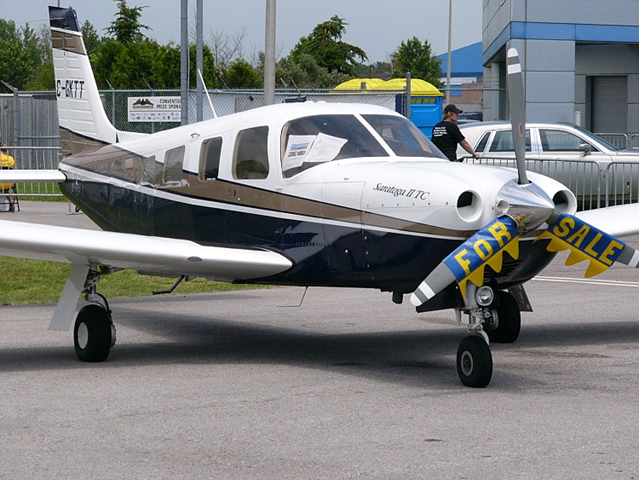
Piper Saratoga, It was exactly ten years ago last week (July 16, 1999) that John F. Kennedy Jr. went missing in his Piper Saratoga near Martha’s Vineyard, Massachusetts. It was later determined by the NTSB that the crash was caused by "The pilot’s failure to maintain control of the airplane during a descent over water at night, which was a result of spatial disorientation." Moreover, the fact that the weather was officially listed as VFR and this allowed Kennedy to fly that night despite his lack of an IFR rating along with his relative inexperience as a pilot (he also had an injured foot and was under stress in his personal life) also contributed to the crash.

Given the recent anniversary, Thomas B. Haines has posted an entry on the AOPA Pilot Blog where he recalls the day after Kennedy disappeared and how he was contacted by the media relations person at Piper Aircraft who said the company needed help from the AOPA because the media was already pouncing on them. Ironically however, on the following day while flying from Maryland to Pennsylvania, Haines found himself nearly in the same situation that Kennedy faced:

It was technically VFR, but the haze was incredibly thick–even by our usual standards. Even in daylight, I was relying mostly on the instruments, happy to have a solid autopilot in the A36 Bonanza I was flying. By my late-morning return to Frederick, the conditions were even worse, but I had wised up enough to file IFR. I couldn’t imagine flying in such conditions at night and over water with no horizon–especially without an instrument rating. What was Junior thinking?

A very good question indeed. Haines makes the point of always having a plan B for when you think you might be heading into a situation that you may not be able to handle as a pilot and this Plan B may even include just staying at home. Good advice worth heeding.

Related posts:

  1. Lessons learned from a fatal Cirrus accident in Zurich
  2. Lessons learned from a mixture control incident
  3. Lessons from a fatal Cirrus crash
  4. 11 lessons from a fatal Cirrus crash
  5. Revisiting the JFK Jr crash: 10 fatal pilot errors

{ 4 comments… read them below or add one }

Matthew Stibbe July 25, 2009 at 07:01

I remember doing my ‘cross-channel check’ in the UK shortly after I passed my PPL back in 2001. Even though the weather was lovely and we were flying to Le Touquet for lunch, my instructor warned me that the horizon would be blurry. In fact, it was more than blurry and mid-channel I was flying on instruments and feeling very pleased that my instructor was with me. I guess if you weren’t expecting this phenomenon, you could easily get caught out.

Vince Foster July 26, 2009 at 21:28

First, this person confirmed that the weather in MARTHA’S VINEYARD the evening of July 16 was generally excellent.

This person was asked to “take a look” at something–an “internal” report by/from the FAA on the circumstances of that event. In particular this report was concerned with the CONDITION of the aircraft.

First, the plane in question flown by Mr. John Kennedy was outfitted with every possible bell and whistle available; as well as the most up-to-date communications devices, emergency beacons, autopilot, instruments, gauges, AND Global Positioning technology. Said FAA report is in MAJOR contradiction to the tone and content of the PUBLICLY–and belatedly–released NTSB report. Said FAA report indicates that the aircraft was subjected to a MASSIVE electromagnetic “event” of some kind or other. EVERY SINGLE lightbulb in the aircraft was blown; filaments burned out. ALL integrated circuitry and communications devices were MELTED, fused, fried and toasted in every sense of the word. The voice recorder system was in fact non-functional anyway. Kennedy had forgotten to put in a 9-volt battery. Chalk one SMALL point up to the “operator error” crowd. Electronic sensing units in fuel and engine areas were also sizzled.

Is this “report” genuine? The real thing? I have no idea, but the person I talked with who saw and held it believes it to be. This person has been a near-perfect source for me in the past.

Matthew Stibbe July 27, 2009 at 06:40

Oh, great. Just what we need – another Kennedy conspiracy theory. With added CAPITAL letters. I wish schools would teach ‘Occam’s razor’ to every student, perhaps tattooing ‘Entia non sunt multiplicanda praeter necessitatem’ on every hand. Then perhaps the world would be spared a lot of this nonsense.

skipper August 19, 2009 at 12:58

WAYNE MADSEN REPORT – “FROM DEEP INSIDE THE WASHINGTON BELTWAY”

August 12, 2009 — JFK Jr.’s Plane Crash Was Originally Treated As Murder Investigation
by Wayne Madsen

WMR has learned from a source who was a close friend of the late John F. Kennedy, Jr. that the FBI originally treated the July 16, 1999, crash of his Piper Saratoga in the waters off Martha’ Vineyard as a murder investigation. Kennedy, his wife Carolyn Bessette Kennedy, and his sister-in-law Lauren Bessette were killed when their plane plummeted into the Atlantic en route from Caldwell Airport in Essex County, New Jersey to Martha’s Vineyard. Kennedy’s wife was also three month’s pregnant with a boy.

Kennedy was to drop off Lauren Bessette at Martha’s Vineyard before flying to Hyannisport to attend his cousin Rory’s wedding.

According to the Kennedy friend, the son of the late president and publisher of “George” magazine, was about ready to announce his run for the U.S. Senate from New York. Kennedy was acutely aware of his vulnerability and hired on a personal security team just prior to his announcing for the Senate. Kennedy also decided, unlike all previous flights, not to file a flight plan at Caldwell. Instead, Kennedy, instead of filing an FAA flight plan, provided his own “flight following” by having a Kennedy friend waiting at the Martha’s Vineyard airport. When the plane was overdue the friend notified Woods Hole Coast Guard Station which, in turn, notified the FAA and other agencies.

According to the source, Kennedy, contrary to press reports, decided not to fly over open ocean from Montauk at the eastern tip of Long Island to the Vineyard but instead hugged the Connecticut and Rhode Island coast lines until flying direct to the island. Kennedy did not identify his ultimate destination on the radio – he said that6 he was flying “east of Teterboro.”

Fearing for his safety, Kennedy thought it best to be within sight of the coastline. According to the Kennedy friend, Kennedy told him his plans prior to his departure. Kennedy had also arranged for all the onboard bags, including his own and that of his family, to be hand searched by security personnel at Caldwell prior to departure. Kennedy decided not to take along a co-pilot because he felt his flight was somewhat of a risk. Kennedy’s friend said Kennedy was always concerned about the “underdog” and did not want to put a co-pilot in any potential danger. In any event, Kennedy felt confident of his and his family’s security since he had retained a security firm to provide for his protection prior to his Senate run announcement.

Media reports at the time of the disappearance suggested that the weather near Martha’s Vineyard was “hazy” and Kennedy may have become disoriented, causing the crash. However, the Kennedy friend states that this was not the case and cites the fact that visibility around the Vineyard was clear at 9:41 pm when the plane disappeared from the sky. The following is from the National Transportation Safety Board (NTSB) report on the crash and quotes the Martha’s Vineyard tower manager:

“During an interview, the tower manager stated that no actions were taken to augment or edit the ASOS during his shift. He also stated the following:

‘The visibility, present weather, and sky condition at the approximate time of the accident was probably a little better than what was being reported. I say this because I remember aircraft on visual approaches saying they had the airport in sight between 10 and 12 miles out. I do recall being able to see those aircraft and I do remember seeing the stars out that night…To the best of my knowledge, the ASOS was working as advertised that day with no reported problems or systems log errors.’”

ASOS is the Automated Surface Observation System. Media reports claimed that visibility was around 2 miles with haze, a far cry from what the tower manager at Martha’s Vineyard stated to the NTSB.

The weather report around the time of the crash also indicated clear weather in the area:

“2053…Clear at or below 12,000 feet; visibility 8 miles; winds 250 degrees at 7 knots; temperature 23 degrees C; dewpoint 19 degrees C; altimeter 30.09 inches of Hg.

2153…Clear at or below 12,000 feet; visibility 10 miles; winds 240 degrees at 10 knots, gusts to 15 knots; temperature 24 degrees C; dewpoint 18 degrees C; altimeter 30.10 inches of Hg”

Some twelve minutes after Kennedy’s plane crashing, visibility around Martha’s Vineyard was reported at 10 miles, described as near perfect conditions by professional pilots.

There were also questions raised about Kennedy’s piloting skills. However, he had logged in 310 hours. The NTSB report also reported Kennedy’s most recent flight record:

“In the 15 months before the accident, the pilot had flown about 35 flight legs either to or from the Essex County/Teterboro, New Jersey, area and the Martha’s Vineyard/Hyannis, Massachusetts, area. The pilot flew over 17 of these legs without a CFI [Certified Flight Instructor] on board, including at least 5 at night. The pilot’s last known flight in the accident airplane without a CFI on board was on May 28, 1999.”

Kennedy’s most recent three legs were with a CFI on board and along the same route taken on July 16 but significant rain and a 800 foot ceiling. Kennedy had, according to his friend, been flying for 17 years. Before Kennedy flew the Piper Saratoga he flew a Cessna 182.

There were also media reports that Kennedy was impeded by a foot cast from an accident he suffered while parasailing. However, according to Kennedy’s friend, the cast had aready been removed when Kennedy took to the skies on July 16.

The Kennedy friend also stated that he learned from an FBI agent, as well as a Secret Service agent, who were friends of the Kennedy family that the FBI originally treated their investigation of the plane crash as a possible murder. Kennedy no longer enjoyed Secret Service protection as a protected person, according to the friend.

FBI agents, after the crash, fanned out across convenience and other stores in the Caldwell, New Jersey area and asked if anyone had recently purchased epoxy. According to the French magazine, France Dimanche, a pilot at the Caldwell airport had reported he heard a “weird noise” coming from Kennedy’s plane on takeoff. The FBI theorized that a whistle had been glued on the aft section of the plane in order to emit a distinct, unique, and high-pitched noise for the benefit of someone on the ground who wanted to correctly identify the plane when it descended for landing at Martha’s Vineyard.

The FBI asked pilots if a whistle attached to the rear of a plane such as Kennedy’s could be heard from the cockpit. The answer from all the pilots was no because the sound would only be heard by those on the ground as the plane passed overhead while descending to an audible range. There was also a belief that if the whistle had been fashioned from a water-soluble material, such as plaster-of-paris, it would have dissolved in the seawater.

The FBI discovered that there was “suspicious boating activity” in an area of Martha’s Vineyard where Kennedy’s plane was descending to 2000 feet for its final approach to the airport. The “suspicious” boaters claimed to be fishing for striped bass. However, when the FBI asked local fishermen to corroborate the suspicious boaters’ story, they stated that the particular area where they were discovered was not an area where Atlantic striped bass would be found. In fact, salt water striped bass do not start to run in Massachusetts coastal waters in great numbers until the autumn.

The FBI also found an unusual number of extra batteries in the fishermens’ boat. The FBI was suspicious of the boat’s contents because after the plane’s wreckage was discovered, investigators found, according to Kennedy’s friend, that every light bulb, including that in the emergency flashlight, had been blown out on the plane and every circuit board, including those in the engine sensors and other electronic equipment, had been literally “melted.” FBI agents on the scene preliminarily concluded that a “massive electromagnetic event” caused Kennedy’s plane to crash. FBI agents also found that the cockpit voice recorder (CVR) had its battery removed, possibly before the flight. Every simulation the FBI conducted of a plane in Kennedy’s situation, with all lights off at night and with only the engine and the vacuum pump-operated attitude indicator functioning, resulted in the same result: the plane crashing into the water.

Before the FBI could begin examining the ocean floor for any “special equipment” that may have been thrown overboard from the fishing boat, their “murder” investigation was abruptly called off by FBI headquarters in Washington.

Kennedy was preparing to re-tool “George” magazine to take on investigations of a number of major stories, not least of which was the actual story behind the assassination of his father in Dallas on November 22, 1963. According to an article in Germany’s Bild am Sonntag on August 1, 1999, Kennedy was also preparing to meet with the deputy chief of Mossad, Amiran Levine, at the Oak Room in Manhattan’s Plaza Hotel the Wednesday after Kennedy was killed. The subject was the assassination of Israel’s Prime Minister Yitzhak Rabin in 1995 and that Rabin was assassinated by one of his body guards and not the convicted murderer Yigal Amir.

Kennedy’s friend said the real priority of the “George” publisher was to re-open the case of the assassination of President John F. Kennedy and the role that the father of the all-but-announced Republican presidential candidate for the upcoming 2000 election — George W. Bush — played in the assassination. Apparently, some documents had come into Kennedy’s possession that pointed to George H. W. Bush as a prime participant, on behalf of the CIA, in President Kennedy’s murder.

On a 1997 visit to see Cuban President Fidel Castro in Havana for an interview for “George,” the Cuban President reportedly told Kennedy a number of details about those behind his father’s assassination. The occasion of Kennedy Jr.’s visit was the 35th anniversary of the Cuban missile crisis between his father and Soviet Premier Nikita Khrushchev. According to Kennedy’s friend, Castro confided to Kennedy that a mafia ring headed up by Meyer Lansky, who lost his Cuban gambling holdings to Castro’s revolution, and a Canadian Zionist veteran of Israel’s Haganah army, Louis Bloomfield, were the primary planners of the Dallas “hit” on his father. Jack Ruby, who killed the alleged assassin Lee Harvey Oswald, worked directly for Lansky’s organization, Kennedy was told.

Although the information on J.F.K. Jr.’s plans to more thoroughly examine the facts of his father’s assassination came from a single source — a friend of the late Kennedy Jr. — this editor is in a unique position to corroborate part of the story.

On Saturday, July 17, 1999, I was driving to a hotel in Crystal City, Virginia to proctor a certification examination for a group of computer security professionals. Listening to the radio, the bulletin came across that John F. Kennedy Jr.’s plane was missing. The news came as a body blow. In a few weeks, I was scheduled to meet with Kennedy at his magazine’s offices in Washington, DC to discuss hiring on as one of a few investigative journalists Kennedy wanted to dig deep into a number of cases, but most importantly that of his father’s assassination. Kennedy had made initial contact with me via a colleague with The Village Voice. I signaled my readiness to do whatever Kennedy wanted because, first of all, I have always been an admirer of the Kennedy family, and after twelve years under Bush presidencies, that admiration has developed into a loyalty for which I make no apologies.

My past discussions with President Kennedy’s press secretary Pierre Salinger and Texas Governor John Connally led me to believe that the young Kennedy was on to the story of a lifetime — a lifetime that for Kennedy Jr. would be tragically snuffed out early.

After I heard the news report about Kennedy’s plane and knowing of his plans, I knew deep down that he was gone and that the renewed investigation of America’s worst crime of the 20th century was dead along with him. Little did I realize at the time, but I heard the news about Kennedy as I was driving along Route 110 past the side of the Pentagon where the worst crime of the 21st century would take place under the administration of George W. Bush.

In the end, Hillary Clinton was elected to the U.S. Senate seat that Kennedy was to run for. Kennedy’s sister, Caroline Kennedy Schlossberg, would see her own hopes to be appointed to the Senate seat dashed when, according to John H. Kennedy Jr.s’ friend, Senator Charles Schumer and Barack Obama chief of staff Rahm Emanuel conspired to have New York Governor David Paterson appoint a virtual unknown, Kirsten Gillibrand, to the seat. Caroline Kennedy was instead offered a consolation prize of the post of U.S. ambassador to the Vatican, a position that Schumer and Emanuel knew in advance she would never accept.

http://www.waynemadsenreport.com/articles/20090812_4

IT WAS THE MOSSAD – Bushes, Clintons, Madeline Albright all involved

Stibbe: Maybe the tatoo should read “Screwed, Blued & Tatooed”

Landsberg: We can hear you whining from here – Was he a dues paying member? ” Denial?

Leave a Comment

Previous post:

Next post: